

Eco-printing process: Kerry edition
Field notes from natural botanical dye experiments in Ireland

The rural Irish landscape in June offered a bounty of botanicals to play with. From the moment I arrived in Dublin, and strapped myself in my rental car, I began scouring the roadside plants for potential materials.
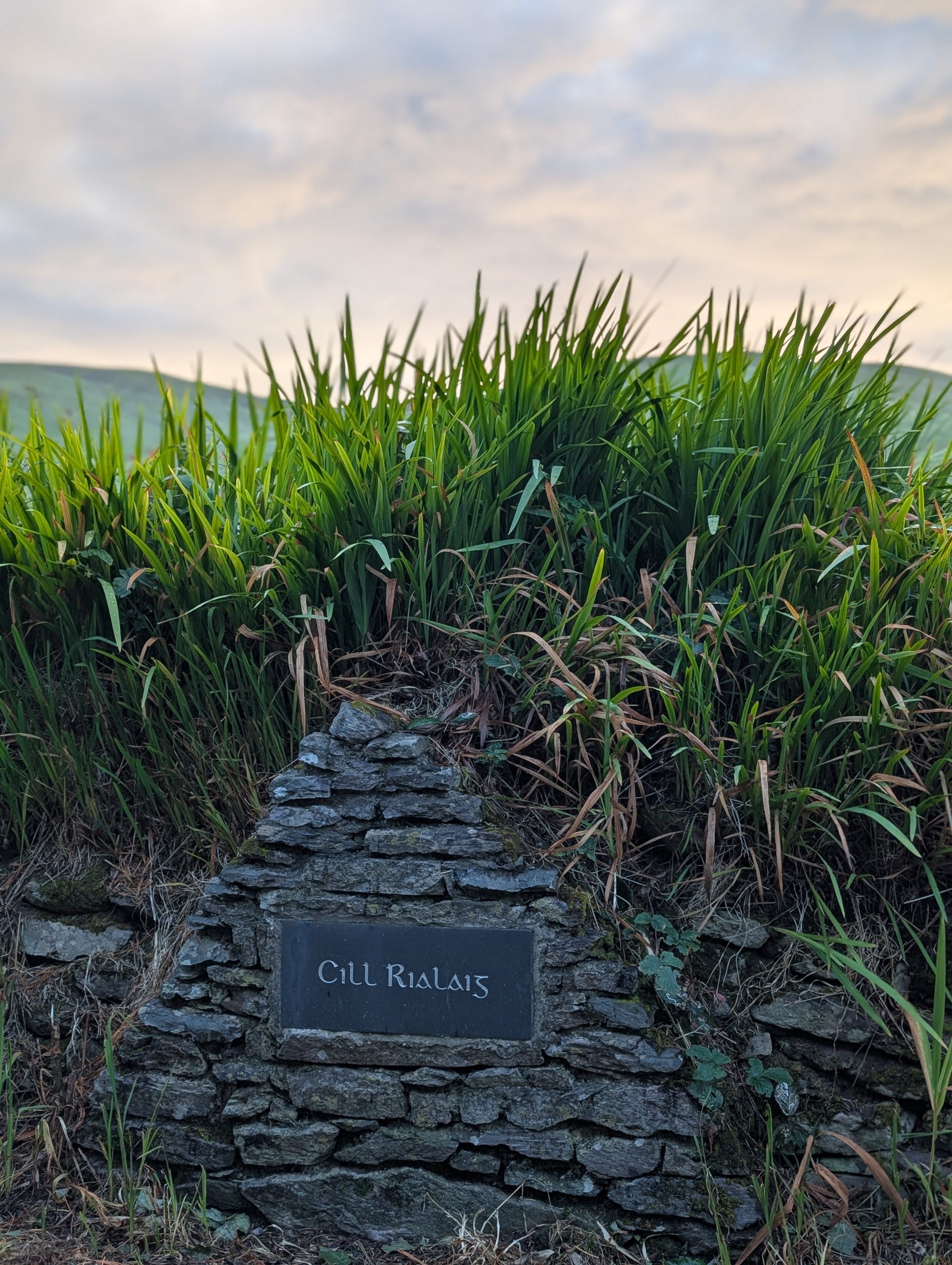
I would have just over a week of dedicated time to conduct experiments for a new textile series inspired by my time at Cill Rialaig, a renowned artist retreat space on the edge of the Atlantic, almost as far west as Ireland goes.
As my compact car took me from the motorway onto more rural roads, I could see the possibilities start to open up. Just about everything was in bud or bloom; and I wasn’t looking at ornate and vibrant flowers here, as some eco-printers search for…I looked over the showy stuff that might photograph well in a flat-lay. I wanted the wild things that nobody had planted on purpose. Hedge weeds, verge plants. Things that might hold a good tannin, leave an interesting and abstract imprint, or have surprising colour in the stems.


I was drawn to the most hardscrabble things, things growing sideways out of ancient stone walls, that had survived the intense wind off the ocean, the salt and the rain, the browsing of sheep. As I picked my way around the Ring of Kerry, I instinctively collected not the prettiest things, but the toughest.
Because my cottage at the Cill Rialaig village was pretty bare bones, and I could only bring the materials I was able to pack along with me, I had to find most of my materials when I landed. I brought a 1.5m swath of white linen along with dozens of smaller swatches, as well as cotton canvas, all pre-scoured at home.
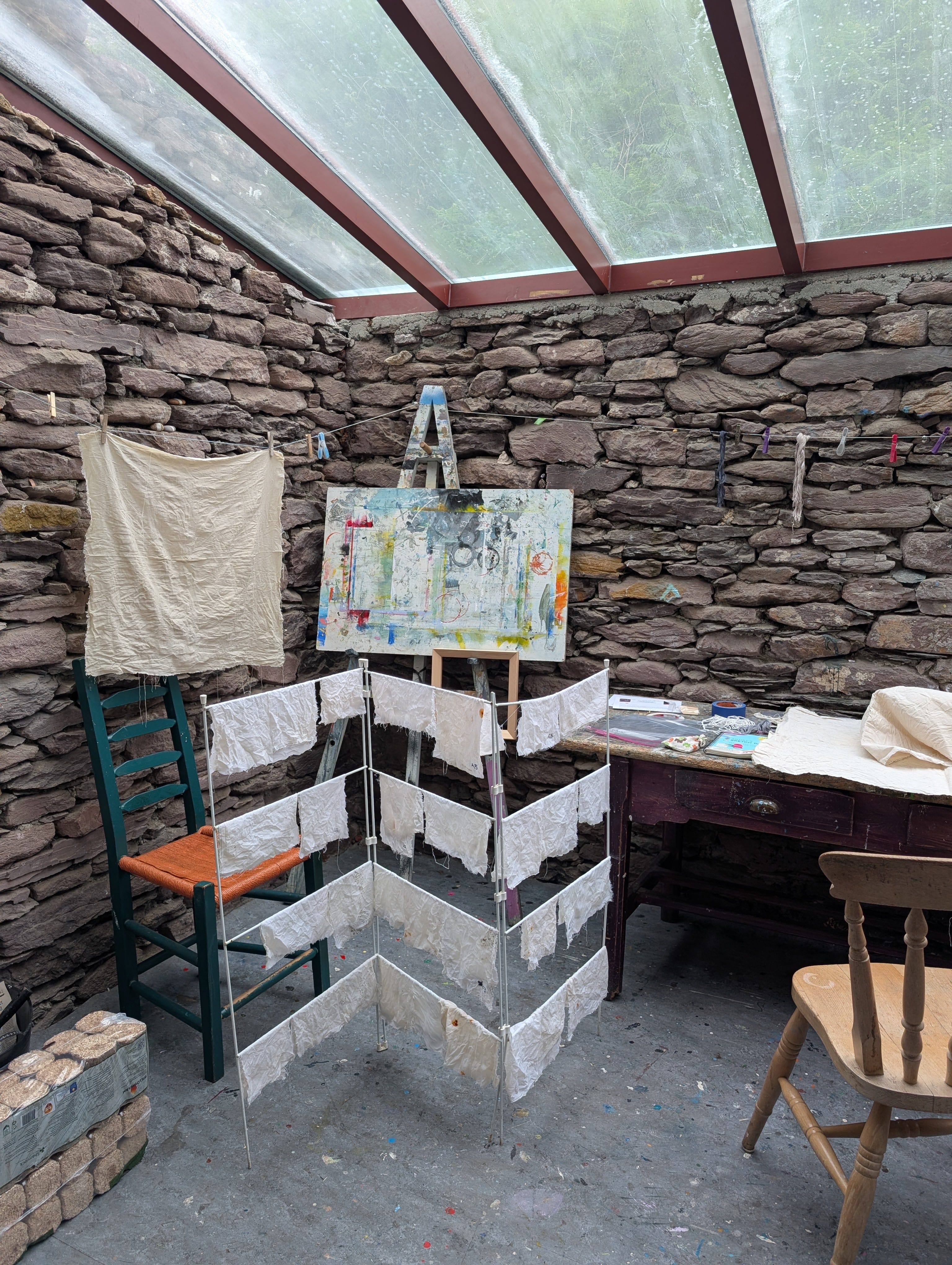
I decided to try out soy milk as a mordant, and spent my first day at the cottage soaking all of the fabric for about 20min and then hanging to dry (no rinsing). I had collected some things from Ballinskelligs Bay: various plants, and most excellently, an old rusty piece of metal on the beach that I would throw in as an iron modifier. I initially thought it was a shell; it’s incredible that I spotted it.


Arriving with pre-cut linen swatches that were already labeled for easy tracking was so helpful. I was able to then quickly snap photos of each plant, so I would have a clear reference of what was what later on when I assessed which results I liked best.


Cill Rialaig asks artists to leave one piece behind for their annual fundraising auction, as the stay at the cottage itself is free of charge for invited residents. They helpfully leave a 12x12” canvas for each artist, but since I am not able to eco-print onto treated canvas, I had to remove the primed canvas from the frame so I could stretch my own raw canvas around it. I was glad I brought my staple-gun. For my gift piece, “Is that the wind?”, I used bell heather, common sorrel, pennywort, ribwort plantain, fuschia, figwort, and pine cones. It truly comes alive in person, like most eco-printed work does, and you can see how it changes with different light and angles.


In addition to steaming bundles, I also tried sauna stewing, which I believe is a term I just invented. For some of the larger bundles I wrapped them up in ziploc bags and let them soak in the sun, in a windowsill, and even in front of the fire one night, getting all juicy and dewy inside the bag.


There is something very special about working with plants. I have tuned my eye to nature, just noticing what’s there — and how that changes so quickly with the seasons. That means each plant I collect represents a sliver of time, my memory of a moment, and the power of that place. That’s what I see when I look at my abstract eco-prints. It’s like a time capsule.
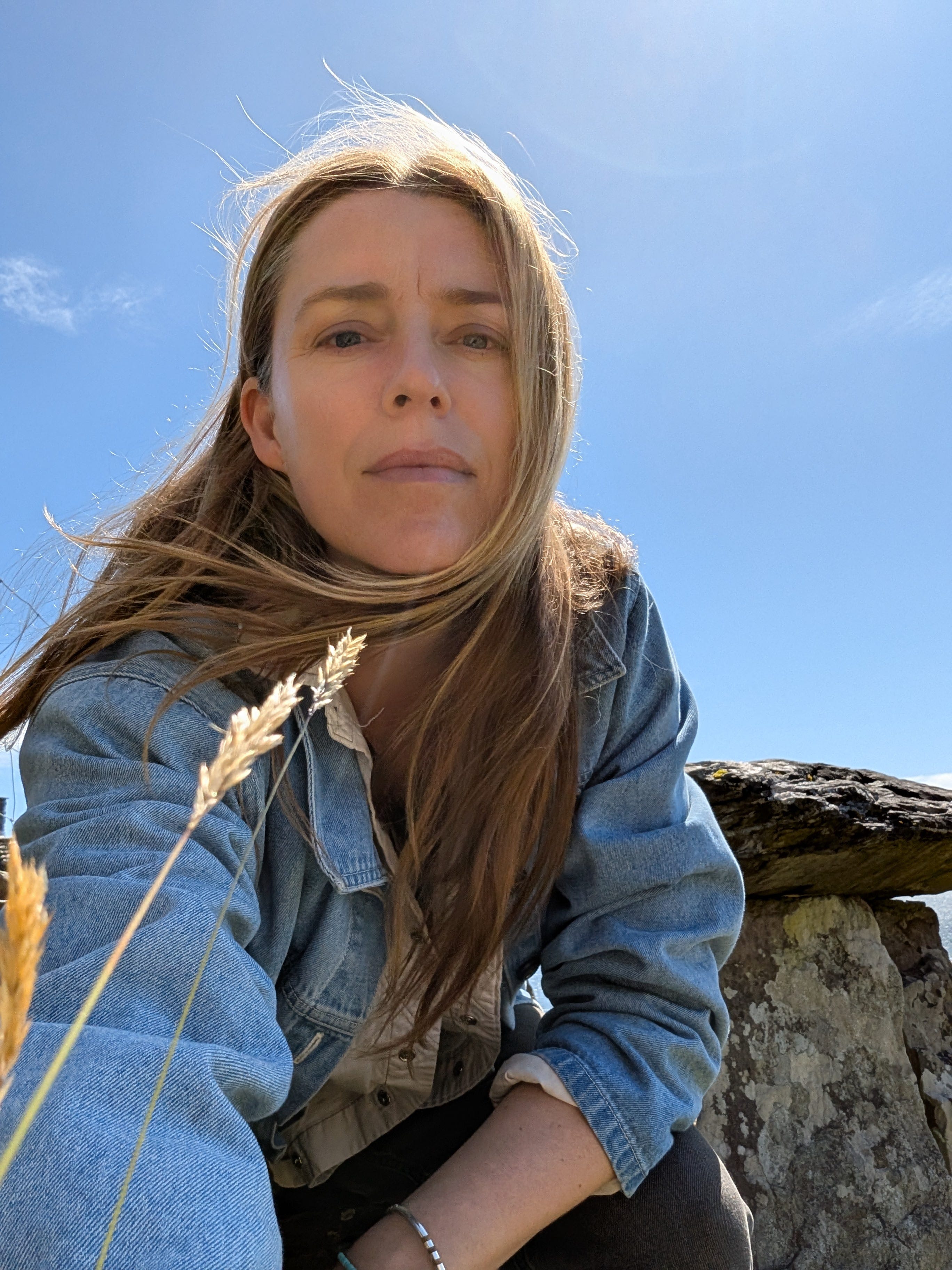
For me, eco-printing is not about rendering a perfect image onto fabric, nor is it about catching crisp lines or forcing out the most robust colour possible. It’s about the alchemy of cultivating presence within an environment, then laying down materials that represent that time and place onto fabric, and seeing what happens without trying to force a particular result. It feels, to me, like encapsulating a bit of magic.
And now, back home on Salt Spring Island, I have a suitcase full of fabric that is waiting to be stretched or sewn or crafted into final works, and that’s an exciting place to be as I continue to work with and integrate my experience in Ireland.
Here’s a full list of the plants I used (and hopefully identified correctly):
Bracken (Pteridium aquilinum)
Royal fern (Osmunda regalis)
Ragwort (Senecio jacobaea)
Bell heather (Erica cinerea)
Common heather / ling (Calluna vulgaris)
Ribwort plantain (Plantago lanceolata)
Sorrel / dock (Rumex species)
Kidney vetch (Anthyllis vulneraria)
Navelwort / pennywort (Umbilicus rupestris)
English stonecrop (Sedum anglicum)
Hardy fuchsia (Fuchsia magellanica)
Figwort (Scrophularia nodosa)
Herb Robert (Geranium robertianum)
Helichrysum / curry plant (Helichrysum italicum)
Selfheal (Prunella vulgaris)
Bramble / blackberry flower (Rubus fruticosus)
Fucus seaweed (bladder wrack / serrated wrack)